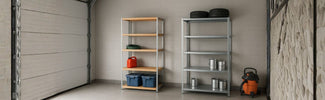
30 cm vs 50 cm Diepe Rekken: Welke Diepte Heb Je Echt Nodig?

30 cm vs 50 cm Deep Shelves – Which Depth Do You Really Need?

, 4 min reading time

Are you planning to make your garage, storage room, or workshop more efficient but unsure which shelf depth to choose? The difference between 30 cm and 50 cm deep shelves affects not only how much you can store but also how safely and comfortably you use the space. In this guide, we compare both depths in terms of space usage, load capacity, applications, and ergonomics so you can easily make the right decision and make the most of your available space.

What does “depth” mean for shelving?

The depth of a shelf refers to the distance from front to back. It determines whether boxes or crates fit entirely on the shelf, how much they can overhang (preferably not at all), and how much walking space you have left. In garages and storage rooms, 30 cm and 50 cm are common depths because they strike a good balance between storage capacity and movement space.

30 cm Deep Shelves – Pros & Cons

30 cm deep shelves are perfect for compact spaces where every centimeter counts. They combine functionality with visibility and fit well in narrow garages, corners, or next to vehicles.

  • Pros
    • Compact: ideal for narrow hallways or next to cars; leaves more walking space.
    • Visible: shallow shelves prevent items from getting “lost” at the back.
    • Safe in tight spaces: less risk of bumping into corners or protruding boxes.
  • Cons
    • Limited box size: larger crates or tires often don’t fit completely.
    • Less volume per level: you may need extra shelves or modules for added capacity.

50 cm Deep Shelves – Pros & Cons

50 cm deep shelves provide extra storage space and stability for heavy or bulky items. They’re ideal for large crates, toolboxes, tires, or seasonal items that require more depth.

  • Pros
    • More storage volume: great for large boxes, tool cases, tires, and archive bins.
    • Flexible use: easily store both small and large items without balancing them on the edge.
    • Better stability for heavy loads: the deeper shelves distribute weight more evenly.
  • Cons
    • Requires more space: less suitable for narrow walkways or tight garages.
    • Deep storage effect: small items can disappear at the back without bins or labels.

When to Choose 30 cm and When 50 cm

Choose 30 cm if…

  • The shelf is placed along a narrow wall or next to a parked car.
  • You mainly store small parts, spray cans, bottles, or compact storage boxes.
  • Quick access and visibility are more important than maximum capacity.

Choose 50 cm if…

  • You need to store large crates, toolboxes, seasonal bins, tire sets, or garden tools.
  • You prefer more stability and surface area for heavy or deep objects.
  • You have enough floor space and value storage capacity over walkway width.

Comparison Table – 30 cm vs 50 cm Deep

Feature 30 cm Deep 50 cm Deep
Space usage Compact; ideal for narrow areas Requires more floor space
Storage volume per level Low–Medium Medium–High
Suitable items Small boxes, spray cans, bottles, hand tools Large crates, cases, tires, seasonal boxes
Visibility & access Excellent; nothing disappears at the back Good; use bins or labels for better organization
Ergonomics Easy to access in narrow spaces More surface area, stable for heavy items

Step-by-Step Buying Guide: How to Determine the Right Depth

  1. Measure available space: account for opening doors, cars, and walkways. For comfort, leave 80–100 cm of free space.
  2. List your items: measure your largest boxes or crates. If they’re deeper than 30 cm, 50 cm is often the safer choice.
  3. Choose the right load capacity: match shelf material (steel/MDF/composite) and number of levels to your needs.
  4. Plan height wisely: place heavy items on middle levels and lighter ones at the top.
  5. Install securely: level the unit and anchor it to the wall to prevent tipping.

Conclusion

Choose 30 cm deep shelves for small spaces and light items, and 50 cm deep shelves if you need more volume or larger storage boxes. By measuring your biggest objects and walkway width beforehand, you’ll make the right choice from the start. Explore Doika’s complete range of shelving units and create a safe, efficient storage setup that fits your space perfectly.


Frequently Asked Questions

What factors determine whether I should choose a 30 cm or 50 cm deep shelf?
The choice depends on your available space, the type of items you want to store, and how much walking room you need. In narrow garages or storage rooms, 30 cm shelves are ideal for compactness and visibility, while 50 cm shelves work best for larger boxes, tool cases, or tires.
What are the advantages of a 30 cm deep shelf in a small garage?
A 30 cm deep shelf saves space and gives you more room to move around. Everything stays visible and easy to reach since nothing gets lost at the back. This makes it perfect for tight hallways or spaces next to vehicles.
Why should I choose a 50 cm deep shelf?
A 50 cm deep shelf provides extra storage capacity and better stability for heavy or bulky items such as toolboxes, tires, or seasonal containers. The wider surface distributes weight more evenly and prevents items from hanging over the edge.
How can I determine the right depth before buying a shelf?
Measure your available space, keeping doors, cars, and walkways in mind. Then list your largest boxes or containers – if they’re deeper than 30 cm, a 50 cm shelf is usually the safer choice. Always leave 80–100 cm of clear walking space for comfort.
What’s the biggest difference in everyday use between 30 cm and 50 cm shelves?
30 cm shelves are compact and safe for small spaces, while 50 cm shelves offer more capacity and flexibility for larger items. It comes down to finding the right balance between visibility and storage volume.

Latest blogs

  • Welke bedrijven leveren brievenbussen met ingebouwde pakketvakken?

    Welke bedrijven leveren brievenbussen met ingebouwde pakketvakken?

    Read more 

  • Top 5 Budget-vriendelijke brievenbussen in 2025: Complete Gids

    Top 5 Budget-Friendly Mailboxes in 2025: Complete Guide

    Read more 

  • De Complete Gids voor Pakketbrievenbussen: Waarom Ze de Moeite Waard Zijn

    The Complete Guide to Parcel Mailboxes: Why They’re Worth It

    Read more 

Previously viewed by you

Login

Forgot your password?

Don't have an account yet?
Create account