
Where should you place a compost bin in the garden?
, 12 min reading time
, 12 min reading time
Placing a compost bin may seem simple until you need to decide which spot in the garden actually works best in everyday use. A poorly accessible location can make filling and emptying unnecessarily difficult, while an unstable or constantly wet area may be less suitable for regular use. In this guide, you’ll learn where to place a compost bin, how to consider airflow, ground conditions, sun, shade and drainage, and which size makes sense for a small, medium-sized or larger garden. This helps you choose a location that suits the available space, how you plan to use the bin and the selected model.
Place a compost bin on stable, easily accessible ground with enough room to fill and empty it comfortably. Make sure ventilation openings or open construction areas are not blocked and check that water does not remain around the composter after rainfall. Sun or shade is not an absolute requirement: focus mainly on whether the location remains practical for the selected model. Also consider the distance from areas where you regularly collect leaves, pruning waste or other organic material.
In a small garden, the available floor space is usually the most important consideration. A compact composter takes up less room and can be easier to position between a patio, storage area, borders or other garden features.
Do not only compare capacity in litres but also check the external dimensions. Make sure the opening and any ventilation areas remain accessible once the composter is in position.
In a medium-sized garden, capacity and accessibility can be balanced more easily. A medium-capacity composter provides extra volume without immediately requiring a large permanent composting area.
A position near borders, lawn areas or other places where organic material is regularly generated can be practical. Make sure enough space remains available to fill and empty the composter normally.
A larger garden offers more possibilities for a permanent composting area and a model with greater capacity. This is particularly useful when larger amounts of leaves, pruning waste or other organic material are collected regularly.
With wider constructions, consider both the footprint of the composter and the working space around it. A model measuring 100 × 100 cm therefore requires considerably more room than a compact bin.
When patios, planting, play areas or storage already occupy much of the available space, the external dimensions become especially important. A taller or narrower model may be easier to accommodate than a wide construction with a large footprint.
Do not compare capacity in litres alone. Also consider how much usable floor space you can dedicate without making other parts of the garden inconvenient.
This compact compost bin is suitable when space is limited or when you process smaller amounts of organic material. Its low weight and compact external dimensions make it easier to find a practical location without creating a large permanent composting area.
This plastic garden composter is a practical middle option for anyone who wants more capacity without needing the space required by a wide wooden composter. Its 220-litre capacity makes it particularly suitable for small to medium-sized gardens where both volume and flexibility matter.
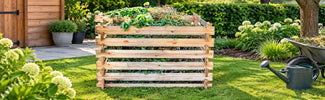
This wooden garden composter offers the largest capacity of the three and is particularly suitable for a spacious, permanent composting area. With a footprint of 100 × 100 cm, it requires more available space but provides room for larger quantities of organic material.
| Model | Capacity | Best use | Mobility | Placement profile |
|---|---|---|---|---|
| Compost Bin 100L | 100 L | Small garden | Easy | Compact location |
| Garden Composter 220L | 220 L | Small to medium-sized garden | Easy | Flexible location |
| Wooden Garden Composter 530L | 530 L | Larger garden | Less suited to frequent moving | Permanent composting area |
The 100-litre compost bin suits anyone with limited available space, those looking for a compact solution or those processing smaller amounts of organic material. The 220-litre garden composter is better suited to users who need more capacity without creating a large permanent area. The 530-litre wooden garden composter is particularly suitable for larger gardens with enough space for a dedicated composting area and greater quantities of organic material.
It can, depending on the model and the conditions at the selected location. Full sun means greater direct exposure, but there is no universal rule stating that it is suitable or unsuitable for every compost bin. Focus mainly on accessibility, ventilation and any product-specific instructions.
Yes, provided the selected model can stand securely on the surface. Check that ventilation openings or other functional areas are not blocked. Different compost bins may have different requirements for the surface underneath them.
There is no fixed distance that applies to every model. Leave enough room to fill and empty the composter easily and to keep ventilation openings accessible. Larger constructions generally require more practical working space.
A compact model with limited external dimensions is generally easier to position when little free garden space is available. In addition to capacity, consider the dimensions, accessibility and the space required to use the model normally.
With clear product specifications, practical selection guidance and transparent information about capacity, dimensions, weight, material and construction, Doika helps you determine which compost bin suits your garden. Compact, medium-sized and larger models can be compared directly so you can estimate in advance how much space each option requires. This allows you to base your choice on verifiable product information, with support relating to delivery, customer service, returns and warranty according to the applicable product conditions.
The best location for a compost bin is stable, easy to reach and spacious enough to fill and empty the model comfortably. Also consider ventilation, drainage, sun, shade and available floor space. View all compost bins or compare the 100L model measuring 48.5 × 52.5 × 75 cm, the 220-litre garden composter and the 530-litre wooden garden composter measuring 100 × 100 × 70 cm.


